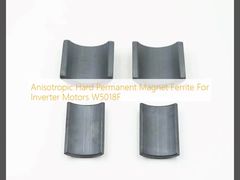
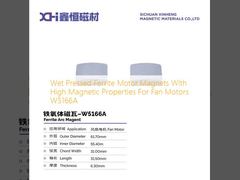
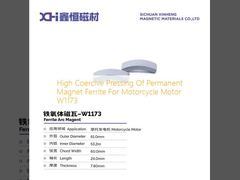
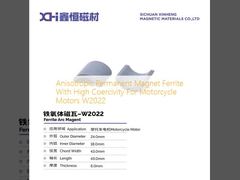
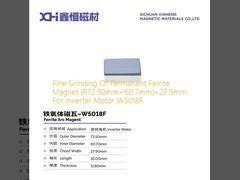
Permanent Magnet Ferrite Produced By 250 Tons Pressure Press For Inverter Motor W5018F

Ferrite Arc Magnet
December 16, 2025
Category Connection: Ferrite Arc Magnet
Brief: See how this offering can bring practical value to common tasks and projects. In this video, you'll witness the manufacturing process of our anisotropic ceramic strontium ferrite magnet, specifically the W5018F model for inverter motors. We'll demonstrate how the 250-ton pressure press enables wet compression molding, creating magnets with high density, strong anisotropy, and excellent magnetic properties. Learn about the key advantages, including cost-effectiveness, temperature stability, and suitability for mass production in automotive and appliance motors.
Related Product Features:
  • Composed primarily of strontium ferrite (SrFe12O19), offering good magnetic properties at a low production cost.
  • Manufactured using wet compression molding with a 250-ton press, ensuring high relative density of around 95% or more after sintering.
  • Exhibits strong magnetocrystalline anisotropy due to its hexagonal crystal structure, providing a preferred direction of magnetization.
  • Features medium to high coercivity, ranging from 700-1000 kA/m, without requiring heavy rare earth elements.
  • Maintains excellent temperature stability with a high Curie temperature of approximately 450°C and reliable performance up to 350°C.
  • Offers high dimensional consistency and uniform shapes, ideal for automated mass production of complex geometries.
  • Provides strong resistance to corrosion as a fully dense ceramic material, unlike bonded magnets with additives.
  • Suitable for various applications, including inverter motors for home appliances, automotive systems, and power tools.
Faqs:
  • What are the key advantages of using strontium ferrite magnets made by wet compression molding?
    These magnets offer low cost due to inexpensive materials and a simple process, high magnetic properties with coercivities up to 1000 kA/m, excellent dimensional consistency for uniform shapes, temperature stability with a Curie point around 450°C, corrosion resistance as dense ceramics, and mass production capability for complex geometries.
  • What applications are Xinheng's permanent ferrite magnets commonly used for?
    They are widely used in automotive motors (starters, wipers, windows), inverter home appliances (washing machines, refrigerators, air conditioners), fan motors, motorcycle motors, electrical tools, and various actuator motors for medical, smart home, and industrial uses.
  • How does the wet compression molding process contribute to the magnet's performance?
    The process involves mixing strontium ferrite powder with a liquid binder and compression molding under high pressure, which orients the anisotropic particles. Subsequent sintering develops density while preserving magnetic anisotropy, resulting in high remanence along the axis and strong mechanical properties.
  • What are the typical physical properties of these sintered ferrite magnets?
    Key properties include a density of 4.8-5.0 g/cm³, Curie temperature of 450°C, maximum operating temperature of 350°C, resistivity over 10⁴ Ω·cm, and strong anti-compressive strength of ≥6.9×10⁸ N/m².